June 9, 2011
-
Nuclear Reactors – Uranium or Thorium?
Got a very interesting request a while back by Prolixity-Split to explain a little about using Thorium as a nuclear fuel instead of Uranium. So here goes my Bookmark-the-Xanga-Guy explanation.
First – we need to realize that fission (splitting an atom) really is a natural process. Big fat atoms like Uranium and Thorium and Plutonium don’t like being big and fat.
Their natural approach to reducing their atomic waistline is to either give off some energy over a long period of time (decay) or go whole-hog and split into two smaller atoms, while tossing out a couple of neutrons and a lot of extra energy (fission). When a bunch of science-guys realized this fission thing was going on they said, “Hey! What happens if we put a whole lot of this stuff close together?” Turns out that when a fat uranium or plutonium atom gets one of those cast off neutrons from another atom, it fissions right away! When a whole lot of them do that at the same time, a whole LOT of energy is released – for good or evil. Einstein put it this way:
E = MC2
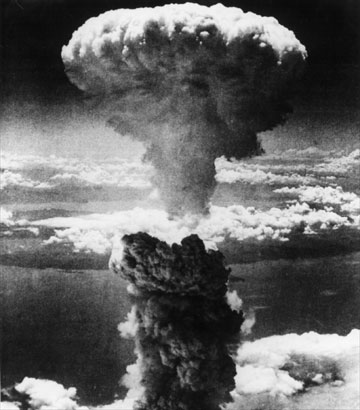
Which is to say – the amount of energy released when matter is converted to energy is equal to its mass times the speed of light squared (roughly 35,000,000,000 miles per second). To give you an idea of that kind of power: If one pound of matter was completely converted to energy, it would be enough energy to lift 1 billion people off the ground to a height of about 6 feet. Boys being boys, and war being war, the military chose to use that knowledge to blow things up … like Hiroshima and the Bikini Atoll.
But I digress …
Uranium is the more common nuclear reactor fuel. It’s cheaper and more stable than Plutonium. Even so, Uranium is still a finite resource with a bit over 5 billion tons of it known to be in existence Thorium on the other hand is not well estimated, but some believe it to be easily 3-4 times more abundant than uranium. Thorium also has a BIG advantage in that 100% of mined Thorium can be used as nuclear fuel. Only 0.7% of mined uranium has that kind of quality. Therefore, Uranium has the added cost of being purified enough to use as a nuclear fuel. These qualities make Thorium a financially attractive nuclear fuel option.
Another really cool thing about Thorium is that it produces far less long-lived radioactive waste than Uranium. And, it doesn’t create much in the way of Plutonium (weapon fuel) as a byproduct.
Sounds GREAT! So what’s the downside?
There are a few technical issues, but the main one is that Thorium needs Uranium to give it a kick in its nuclear pants to start the nuclear reaction.
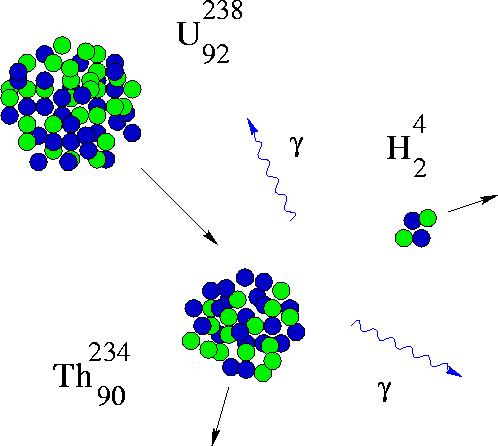
That means the fuel would need to be a mixture of a small amount of Uranium with a large amount of Thorium. That’s extra work. And since Uranium is still relatively cheap and can start its nuclear reaction all by itself, most people don’t think that extra work is worth the time right now. Also – thorium reactors are still experimental in design, which is a polite way of saying “small.” A lot of money still needs to be invested to get a reactor design that is economically profitable. After Fukushima, I’m going to guess the Fat Cats with lots of cash aren’t going to be investing big money in experimental reactors for a while.
But – keep your eyes on up-and-coming nations like India and China. I wouldn’t be surprised to see them take the lead in that field.
Hope you enjoyed the read and that you have a SMASHING good day!
Comments (12)
This is very informative.
It's a shame that people are leery after Fukushima, but it's inevitable given the scale of the disaster. I do hope they eventually pour more money into Thorium research (or barring that, fusion research.... *evil laugh*)
Excellent post!
As always, you're very good at explaining the crazy out there stuff to the common peeps!
You're able to explain this stuff so that I almost actually understand it!
Is the forum open for questions now?
Isn't the fact that Thorium needs a little help from Uranium to get started ALSO a benefit? I mean, doesn't that make it a little safer than Uranium fueled reactors in the sense that a reactor has a finite ability to produce energy and meltdowns, if you will, are less likely?
It seems like it would work that way, but you're the Xanga Science Guy. What'cha think?
On FB someone linked this article regarding a possible melt-through in Japan. Do you have any insider information on that? http://www.naturalnews.com/032657_Fukushima_meltdown.html#ixzz1Old83tHF
@Prolixity_Split - Most of the protection against meltdown has to do with thorium reactors using liquid salt as the coolant as opposed to water, which is used in most uranium reactors. Meltdowns can occur because even after shutdown, the nuclear fuel remains thermally hot for several days. If cooling is lost, the core will melt. That can cause additional fission reactions, but the problem is caused primarily from loss of cooling - not the stored uranium energy. The liquid salt in thorium reactor designs are able to remove the heat much more efficiently than water, so meltdowns are much more unlikely. In some designs, the thorium is actually dissolved within the salt itself, which completely eliminates a core meltdown! It really is a fascinating technology.
@BookMark61 - So, this has your tentative seal of approval, it sounds like. Thank you very much for writing this blog and explaining it.
@Roadkill_Spatula - Well ... let me first say that I knew the situation was far worse than Japan was admitting at the time. My posts, which were written as the situation unfolded support that.
That said - as bad as the situation is, there is still a LOT of drama added that just isn't true. It's likely that one or more of the cores had a "melt through" of the primary containment - but that wouldn't make the entire country of Japan "uninhabitable" as cited in the article. At this point in the recovery, it just means its a lot bigger mess to clean up.
People tend to get a little overly-concerned about the impact of radiation because it's not easy to understand. Picture the damaged core as a pot of poison on the kitchen stove. It got left on, overheated and began leaking out of the lid. Eventually, the gas was cut to the house, so the stove was turned off and the pot cooled down. The kitchen(reactor site) is uninhabitable without special protection, the living room (area around the site) can be cleaned up, but it will take a while. Once the team got into the kitchen to look at the pot, they notice the bottom has a hole in it. It's going to be a lot harder to clean up the mess than sealing the pot and hauling it off - but it doesn't really change what's going on in the area around it.
Thanks.
You are so smart! This IS rocket science!!
very good
Wow... that was informative and easy to understand. Thanks for posting man. And happy Five-O.
Comments are closed.